by Terry Cerata
Possibly no crime has been as written about, debated, or studied as the killing of John F. Kennedy, 35th president of the United States of America.
With the possible exception of his alleged slayer's murder no individual death has been as photographed, filmed and, possibly, audio recorded as well. In the long pantheon of historic acts his killing stands out. For many it's still viewed as an unsolved crime.
If there are any events which have received similar examinations, the Second World War, the American Civil War, for instance, they, though undoubtedly more significant in importance and influence have nonetheless not shared in the positively obsessive concern the JFK assassination has experienced.
Like Abraham Lincoln's murder the crime of November 22, 1963 has been told, repeated, told, and repeated again by legions of others for many decades, with no apparent end in sight.
Unlike the 16th president's demise, however, Kennedy's death has many radically different versions.
Whether or not John Booth and his ragtag cabal of misfits were independent players, mercenaries out to collect a bounty offered by a defeated confederacy, or mere pawns, Lincoln's manner of death has never been in dispute.
Whereas Kennedy's end is not only surrounded in a fog of enigmas from the who and the why, but the how as well. There's not even agreement on the number of bullets which struck the man, let alone the number of assassins.
This year marks the fiftieth anniversary since its occurrence.
And even with the tens of thousands of books, articles, documentaries, and movies espousing whatever angle their authors contrive, proclaiming to conclusively reveal the unadulterated details of this affair, it's apparent the murder's resolution is unresolved for most who still share an interest in it.
Five decades is quite a long time for something to remain a mystery. Particularly one of an event so public as this. Polls and surveys are periodically presented to the public on the Kennedy assassination, revealing a belief that some sort of conspiracy, or not, was behind it.
No more information than that, however. Nothing specific about exactly why such a faith, pro or con, persists, or what depth of knowledge the respondent actually possesses to justify such an opinion.
Merely "a majority of Americans believe this," or 70-odd percent are convinced of that. No more enlightening than chat room blogs. But of course it's never really meant to be.
When the topic of his assassination is highlighted on television, for example, invariably the aim is to ridicule those who harbor views contrary to the official conclusion of a lone gun killer, by the name of Lee Harvey Oswald.
Even if a substantial portion of the various eyewitnesses to events surrounding the crime had a very different story to tell. Kennedy's murder has largely been presented to the public by media reps for entertainment value, not for knowledge.
Simply a device to generate an audience for the purpose of pushing more snack foods and car wax. And that's the other reason this matter is still with us - the media and its collective lax of integrity.
Performers playing the role of journalists, to distract and misinform the ignorant masses. Almost from the beginning John Kennedy's murder was presented to the public as the awful but aberrant deed of some sad unfortunate ne'er-do-well with an ill-defined motive. A nutcase did it. End of story.
No literary presentation has genuinely satisfied the flocks with the definitive expression on the Kennedy killing, not even the work which essentially started it all: The Warren Report.
It appears whatever offering by whichever author on this matter will not fully convince everyone the truth has been revealed, be it by respected investigators, or by smarmy opportunists.
So why should you spend your valuable time wading through yet another tome on this well-trod topic by yet another author whom you've never heard of, and whose credentials may be suspect?
Essentially the answer by now should be self-evident: it isn't important who I am, or who anyone else is for that matter, but whether an honest and reasonable argument has been made which answers hard questions with either indisputable facts, or at the very least intelligent responses.
Earl Warren, Arlen Spector, and Gerald Ford are all well-known people; people whose version of the Kennedy assassination has been judged by most who know it as lacking integrity.
Likewise, authors of thick books on this crime who have name recognition in areas some may view as relevant to understanding how crimes, and particularly murders, are committed have also been scrutinized and have generally fared no better.
It's not reputations, but contributions. Not the messenger but the message is what matters most.
Numerous voices over the years have been quite vague on the explanation of who killed John Kennedy, starting with the panel of esteemed gentlemen for the Warren Commission, their view being that a man named Lee Harvey Oswald was the killer, yet never really ironed down who he was or what actually motivated him to slay the President, other than a meandering, foggy profile cut from the worst fevered fantasies that bunker-addled conservative Americans conjure.
He was a Marxist who worshipped Fidel Castro and espoused the virtues of the Soviet Union, and whose reason for doing it were somewhat unclear but as Oswald was unbalanced (never mind that there's no germane evidence supporting this) that's to be expected.
For the Warren reporters Oswald murdered simply for no reason at all, but what does it really matter as he was crazy.
Conspiracy adherents have not necessarily been any better with their indictments of groups delineated with comic book names like "the shadow government," or "the secret team," or "the powerful elite," without actually naming any specific person within these imagined coteries.
It's simply left to the reader of these writer's words to pick their poison. I'm surprised that "the dark empire" hasn't yet made the list. And of those few who do name names the connections are often an embarrassment in logic, or should be so for those making such claims.
Yet it must also be acknowledged that it has been largely a dedicated cadre of intelligent "nobodies" who are greatly responsible for the truths and facts about this murder which we can and have come to appreciate.
The obvious fact that Kennedy's throat wound was meant to be a head wound makes clear the plan was one bullet fired from a high velocity rifle through his skull. Had this projectile struck it's meant for target there would have been no need for more gunfire.
As the presidential limousine descended the slight incline and curve of Elm Street the bullet intended to blow JFK's brains out went instead through the automobile's windshield. The result of the gunman over compensating for the moving target, tracking his quarry too far down.
The missile then passed John Connelly, sitting directly in front of the President, before entering Kennedy's throat, never exiting his body.
That the bullet evidently hit its target after penetrating the thick windshield, and that there was no known nor reported bullet damage to the car's backseat or trunk, and no damage to the closely following Secret Service vehicle presents compelling evidence that a high velocity rifle fired a missile into the President, which then lodged in his upper torso.
Somewhat similar to the fatal injury suffered by Martin Luther King, but with considerably less devastation.
Observe the famous Abraham Zapruder home movie of the murder.
As the limousine emerges from behind the freeway sign, as Kennedy clutches at his injury, what is John Connelly doing? What does it really look like? A man responding to near fatal bullet injuries to the right of his body, as the official version assumes? Or a man reacting as if something has just passed his left arm?
A through-and-through bullet hole in the car's windshield was detected by numerous onlookers at Parkland Memorial Hospital minutes later.
Some with weapons experience insisted that the hole indicated a bullet shot into the limousine from the front (Secret Service representatives would subsequently display a series of images of several shattered limousine windshields in an effort to discredit eyewitness claims of a single hole).
There's at least one photograph made public showing the windshield purportedly before its removal from the limousine with what appears to be a large crack. Not a complete hole. This photo isn't particularly clear however.
Evalea Glanges, then a second year medical student - and avid hunter, stated the hole was clean through, without cracks, as would be the result from a "high velocity bullet."
The hole was so small that she hadn't immediately noticed it, even after visually searching the body of the car for quite a while.
Some federal agents, Dallas Police, Ford Motor Company technicians, and other eyewitnesses would likewise reveal to researchers that they too saw something similar to Ms. Glanges observation.
Plainly if what witnesses stated and this photo suggest is accurate, a bullet hole just slightly left and near even to the rearview mirror (from JFK's perspective), Kennedy's and Connelly's respective postures to that hole, the angle and location of the car's position on Elm Street at the moment JFK is hit, places a rifleman left-front (southwest) of the limousine.
Undoubtedly many of you will disagree with this premise. I simply ask again, what is Connelly actually doing at exactly the same instant Kennedy reacts to his trauma?
As tragic as John Kennedy's murder was it is necessary still to see the Zapruder film of it in order to get a reasonably factual appreciation of this crime.
Otherwise you allow yourself to be at the mercy of others and their agendas (including mine), describing what they think - or want you to think, is revealed in it.
Such as attempts to convince you that if Kennedy was sitting and tilted a certain way, and if Connelly was turned and bent another way, than one bullet could have done what the lone-nutters insist it did.
Or that the minor difference between elevations of JFK's and the governor's seats made a Texas School Book Depository building trajectory feasible. Theories be damned. Seeing the film for yourself matters.
You'll witness how others in the limousine behave the instant bullets strike. In particular you'll see the actions, or lack thereof, the two Secret Service agents seated at front display. Which may give you reason to question the missile through the windshield claim I've made.
These trained bodyguards appear to notice nothing as presumably noticeable as a bullet smashing through the windshield. I'll give you that.
However, you might also observe how these professional protectors seem pretty much oblivious of anything else shortly afterward as well: of Governor and Mrs. Connelly screaming immediately behind them, for example.
One, John Connelly, heard by several bystanders, yelling in terror, "My God! They're going to kill us all!" And Jacqueline Kennedy shrieking, "No, no, no!!" More sharp noises. In addition to a fellow agent running desperately after them from behind. You know, someone else might have easily construed these as clues.
As a minor digression, one of the legends which has grown around the Zapruder film is that it was first shown to a national American audience on "Good Night America," a television talk show on ABC hosted by Geraldo Rivera.
He and others have claimed, and continue to claim, that Rivera was the first to air this movie nationwide. Those with poor research skills have repeated this fiction.
I guess this is an example of one of the benefits of age, since I personally remember Tom Snyder was in fact the first to air this historic film coast to coast on his late night/early morning talk show "Tomorrow" on NBC in 1975.
Little mention was made it would be showing, as my memory serves. I didn't see it then.
The second person to present this essential piece of evidence was Lou Gordon, who hosted a nationally syndicated late night talk show based in Detroit. This is when I first viewed it, and I particularly remember the gasps from his live audience when the instant Kennedy's death occurred.
I lived in San Francisco at the time, so this was by definition "national." The second time I experienced that same televised response from an audience was from Rivera's show (maybe the distinction was originally meant to be understood as the first "primetime network" airing).
At best he was the third person to air the film nationwide.
It's impossible to know with absolute certitude when or in what sequence subsequent bullets were fired, other than the death bullet, in my opinion.
The projectiles which followed Kennedy's throat wound, not necessarily in the order presented here, came from the Dal-Tex Building, directly across Houston Street from the Texas School Book Depository Building, behind and high from the two gunmen situated at the rear of their prey.
Based on what do I make such an assertion?
The evidence from my perspective is no better than the evidence others have claimed which contradicts it, by "proving" the bullets paths cleanly back to where Mr. Oswald was said to be, by the Warren Commission defenders.
I could show you photos, draw lines to buildings, and do the many other routines you may have come to expect from people discussing this subject. But it really wouldn't prove a thing.
Even if you took surveyor's tools and personally measured what you could at the actual murder site, you'd only get a little closer to the truth, but no more. My main testimony is in what makes more sense to me than not.
It's time to get real. Nearly all of the actual evidence related to this matter was abused through purposeful neglect, and apparent destruction long, long ago. You honestly can't make your case without the tangible items people have talked and talked about over these many years.
A conspiracy can't be proven. But neither can the single gun theory. What can be done is to make a very persuasive presentation which doesn't require exaggerated notions, or ridiculous lies. Or any lie.
This was after all simply a murder. By an orchestrated ambush, but still just a murder. Beings from another galaxy didn't happen to involve themselves in this crime with their big brains, and technology beyond the grasp of puny Earthlings.
This homicide is not all that complicated, aside from the demonstrable subterfuge and deceit by certain others. It's truly not so difficult to understand.
Excerpt from the book "For Sake of Nation" by Terry Cerata, available on Amazon Kindle here at http://www.amazon.com/For-Sake-of-Nation-eBook/dp/B00B4A292C
Article Source: http://EzineArticles.com/?expert=Terry_Cerata
http://EzineArticles.com/?On-the-Kennedy-Assassination&id=7818336
Showing posts with label Book Review. Show all posts
Showing posts with label Book Review. Show all posts
Saturday, June 29, 2013


Saturday, April 6, 2013
The Forbidden History of the Black Panther Party
 |
| Cover - Uni of California Press |
Find out why a clear-cut history of the evolution and politics of the Black Panther Party remains unknown.
Black Against Empire (University of California Press, 2013) is the first comprehensive overview and analysis of the history and politics of the Black Panther Party.
Authors Joshua Bloom and Waldo E. Martin, Jr., analyze key political questions, such as why so many young black people across the country risked their lives for the revolution, why the Party grew most rapidly during the height of repression, and why allies abandoned the Party at its peak of influence.
Learn about why it has been difficult to construct a clear history of the evolution of the Black Panther Party in this excerpt from the introduction.
The Panthers shut out the pack of zealous reporters and kept the door locked all day, but now the hallway was empty. Huey Newton and two comrades casually walked from the luxury suite down to the lobby and slipped out of the Hong Kong Hilton.
Their official escort took them straight across the border, and after a short flight, they exited the plane in Beijing, where they were greeted by cheering throngs.
It was late September 1971, and U.S. national security adviser Henry Kissinger had just visited China a couple months earlier.
The United States was proposing a visit to China by President Nixon himself and looking toward normalization of diplomatic relations. The Chinese leaders held varied views of these prospects and had not yet revealed whether they would accept a visit from Nixon.
But the Chinese government had been in frequent communication with the Black Panther Party, had hosted a Panther delegation a year earlier, and had personally invited Huey Newton, the Party’s leader, to visit.
With Nixon attempting to arrange a visit, Newton decided to accept the invitation and beat Nixon to China.
When Zhou Enlai, the Chinese premier, greeted Newton in Beijing, Newton took Zhou’s right hand between both his own hands. Zhou clasped Newton’s wrist with his left hand, and the two men looked deeply into each other’s eyes.
Newton presented a formal petition requesting that China “negotiate with ... Nixon for the freedom of the oppressed peoples of the world.” Then the two sat down for a private meeting.
On National Day, the October 1 anniversary of the founding of the People’s Republic of China, Premier Zhou honored the Panthers as national guests.
Tens of thousands of Chinese gathered in Tiananmen Square, waving red flags and applauding the Panthers. Revolutionary theater groups, folk dancers, acrobats, and the revolutionary ballet performed.
Huge red banners declared, “Peoples of the World, Unite to destroy the American aggressors and their lackeys.” At the official state dinner, first lady Jiang Qing sat with the Panthers.
A New York Times editorial encouraged Nixon “to think positively about Communist China and to ignore such potential sources of friction as the honors shown to Black Panther leader Huey Newton.”
Friday, October 12, 2012
NEW BOOK REVIEW: The John Lennon Letters
by RetroKimmer.com: http://www.retrokimmer.com/2012/10/new-book-john-lennon-letters.html
 “The
John Lennon Letters” (also available in the United Kingdom, Japan,
Germany and Canada) which hits the streets Oct. 9 when he would have
turned 72, is a birthday gift to us all.
“The
John Lennon Letters” (also available in the United Kingdom, Japan,
Germany and Canada) which hits the streets Oct. 9 when he would have
turned 72, is a birthday gift to us all.
The massive 392 page book is filled with almost 300 letters and documents dating from his childhood to the day of his death, including what was possibly his final autograph.
These aren't just a pile of papers from unimportant times in his life.
There are letters written while the Beatles were in Hamburg, during the days of Beatlemania and on his own after the Beatles had broken up.
But the marvelous thing about the book, which was compiled by author Hunter Davies, who wrote the Beatles' authorized biography, is the pure emotion contained in the letters.
And while Lennon was often thought of very imaginative and hard, and there are examples of that, the book shows he could also be very tender.

The massive 392 page book is filled with almost 300 letters and documents dating from his childhood to the day of his death, including what was possibly his final autograph.
These aren't just a pile of papers from unimportant times in his life.
There are letters written while the Beatles were in Hamburg, during the days of Beatlemania and on his own after the Beatles had broken up.
But the marvelous thing about the book, which was compiled by author Hunter Davies, who wrote the Beatles' authorized biography, is the pure emotion contained in the letters.
And while Lennon was often thought of very imaginative and hard, and there are examples of that, the book shows he could also be very tender.
Saturday, October 6, 2012
BOOK REVIEW: Neil Young: "Waging Heavy Peace"
by Alexis Petridis, The Guardian: http://www.guardian.co.uk
Neil Young's marvellously idiosyncratic autobiography, Waging Heavy Peace, rummages through his 50-year career - and offered its writer a relief from music.
There are perhaps more relaxing preparations for interviewing Neil Young about his autobiography than reading Neil Young's autobiography. It's not that Waging Heavy Peace
isn't a good book. It is, albeit in a very Neil Young-ish way.
Over the course of its 500 pages, Waging Heavy Peace is variously wildly idiosyncratic, unpredictable, bafflingly digressive, wryly funny, deeply moving, plain-speaking, still in thrall to the mysticism of the late 60s, painfully honest - "do not doubt me in my sincerity," counsels Young at one point, "for it is this which has brought us to each other now" - infuriatingly elusive and shot through with moments of rare insight and beauty, which you might say makes it the perfect literary counterpart to the 50-year career it describes, in a fairly roundabout way.
Anyone hoping for a chronological hop through Young's triumphs - the astonishing run of albums that stretches from 1969's Everybody Knows This is Nowhere to 1979's Rust Never Sleeps, the supergroup Crosby, Stills, Nash & Young, his early 90s resurgence, borne by the alt-rock scene his music inspired - is going to go home very disappointed indeed.
The main criticism of it is that it has a tendency to ramble, but as fans at Crazy Horse's recent show in New York's Central Park would have told you - perhaps as their version of 1991's Love and Only Love entered its 14th minute, with no sign of a conclusion in sight - Young is an artist who has always reserved the right to ramble on a bit.
The problem, at least for the prospective interviewer, and particularly if the interviewer is a huge, hawkish Young fan, comes when you reach the part where Young reveals his feelings about interviews.
"I hate interviews," he offers, fairly unequivocally. Journalists, meanwhile, are "jerks" and "dickheads". He is specifically referring to the journalists from Associated Press present at the infamous mid-80s interview when Young - he of the peace signs on his guitar strap and the song about how he never knew a man could tell so many lies until he saw Richard Nixon - appeared to voice support for Ronald Reagan.
But you somehow get the feeling it extends to the profession as a whole. Still, at least the prospective interviewer can console himself with the fact that he's not a blogger, by contrast with whom journalists appear to be his favourite people in the world.
Still, crackling down the line from his New York publisher's office, the 66-year-old sounds affable enough. If I never exactly get the impression that talking to me is the highlight of his day, at least it's nothing compared with some of the stories that circulate among quaking hacks who have made his acquaintance over the years.
It might help that I can't see him: Young's eyes apparently have a habit of fixing journalists with a glare that causes them to wake in a cold sweat years after their encounter. "Back in the beginning I was averse to doing press because I'm not really comfortable with reading about myself," he offers.
"It pisses me off that I can't just create art and have the art stand on its own. I would say, hey, if it's a great album it's going to sell … if it sucks, you know, no one's going to buy it. If it's mediocre, some people will buy it, or it could be great and nobody will get it. But it doesn't make any difference what you say about it."
Nevertheless, he says, Waging Heavy Peace isn't intended as a rebuttal, a misunderstood artist setting the facts straight: he professes not to care about the shelfloads of books that have already been written about him.
"There's nothing much I can do about it and it doesn't matter to me. I find it of interest just to look at it and go, hey wow, that's something else. What am I going to do with it? I don't know what to do with it."
In fact, the book seems to have very prosaic reasons for existing. "Writing is very convenient, has a low expense and is a great way to pass the time," he tells the reader at one juncture, with admirable candour. "I highly recommend it to any old rocker who is out of cash and doesn't know what to do next."
Young needed the money, because he appears to spend it as fast as he earns it. Not, it should be noted, on rock star fripperies, but on vast, complex non-musical projects about which he talks at length in Waging Heavy Peace: his Lincvolt electric car, his inventions for model railways, and his proprietary music system Pono, an iPod rival he says delivers perfect studio sound quality.
He had the time because he broke his toe and was unable to play live: "My manager had mentioned that Penguin was interested in me doing my memoirs, but I hadn't thought much about it. But then when I broke my toe I was just sitting there going, what am I gonna do now? I thought: why don't I just do that book?"
To compound matters further, the author of Homegrown and Roll Another Number for the Road had given up smoking marijuana and drinking alcohol on his doctor's advice: he suffered a brain aneurysm in 2005, the same year his father died after a long struggle with Alzheimer's.
He says that he had barely written a song in 40 years without smoking weed: according to the book, he had literally never performed with his most celebrated backing band Crazy Horse straight. Waging Heavy Peace is underpinned by a struggle to connect with his muse without the aid of a smoke. Given that he is about to release his second new album this year, it's a struggle he clearly overcame.
Arriving hot on the heels of Americana, which featured Young and Crazy Horse singing the British national anthem, Psychedelic Pill opens with a track that clocks in at nearly 28 minutes: clearly Young's cranky eccentricity has survived sobriety intact.
In Waging Heavy Peace, however, there are moments when Young openly wonders if he'll ever complete another song. "How fucking loose do I have to be to write a song?" he protests at one point.
To read further, go to: http://www.guardian.co.uk/music/2012/oct/04/neil-young-autobiography-relief-music
Neil Young's marvellously idiosyncratic autobiography, Waging Heavy Peace, rummages through his 50-year career - and offered its writer a relief from music.
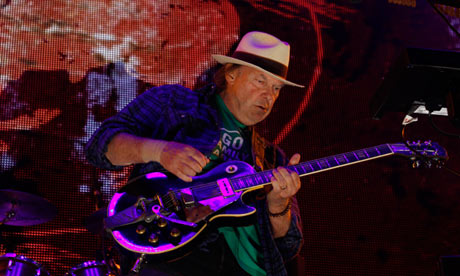 |
| Neil Young with Crazy Horse during Farm Aid 2012 (Photo: Jacqueline Larma/AP) |
Over the course of its 500 pages, Waging Heavy Peace is variously wildly idiosyncratic, unpredictable, bafflingly digressive, wryly funny, deeply moving, plain-speaking, still in thrall to the mysticism of the late 60s, painfully honest - "do not doubt me in my sincerity," counsels Young at one point, "for it is this which has brought us to each other now" - infuriatingly elusive and shot through with moments of rare insight and beauty, which you might say makes it the perfect literary counterpart to the 50-year career it describes, in a fairly roundabout way.
Anyone hoping for a chronological hop through Young's triumphs - the astonishing run of albums that stretches from 1969's Everybody Knows This is Nowhere to 1979's Rust Never Sleeps, the supergroup Crosby, Stills, Nash & Young, his early 90s resurgence, borne by the alt-rock scene his music inspired - is going to go home very disappointed indeed.
The main criticism of it is that it has a tendency to ramble, but as fans at Crazy Horse's recent show in New York's Central Park would have told you - perhaps as their version of 1991's Love and Only Love entered its 14th minute, with no sign of a conclusion in sight - Young is an artist who has always reserved the right to ramble on a bit.
The problem, at least for the prospective interviewer, and particularly if the interviewer is a huge, hawkish Young fan, comes when you reach the part where Young reveals his feelings about interviews.
"I hate interviews," he offers, fairly unequivocally. Journalists, meanwhile, are "jerks" and "dickheads". He is specifically referring to the journalists from Associated Press present at the infamous mid-80s interview when Young - he of the peace signs on his guitar strap and the song about how he never knew a man could tell so many lies until he saw Richard Nixon - appeared to voice support for Ronald Reagan.
But you somehow get the feeling it extends to the profession as a whole. Still, at least the prospective interviewer can console himself with the fact that he's not a blogger, by contrast with whom journalists appear to be his favourite people in the world.
Still, crackling down the line from his New York publisher's office, the 66-year-old sounds affable enough. If I never exactly get the impression that talking to me is the highlight of his day, at least it's nothing compared with some of the stories that circulate among quaking hacks who have made his acquaintance over the years.
It might help that I can't see him: Young's eyes apparently have a habit of fixing journalists with a glare that causes them to wake in a cold sweat years after their encounter. "Back in the beginning I was averse to doing press because I'm not really comfortable with reading about myself," he offers.
"It pisses me off that I can't just create art and have the art stand on its own. I would say, hey, if it's a great album it's going to sell … if it sucks, you know, no one's going to buy it. If it's mediocre, some people will buy it, or it could be great and nobody will get it. But it doesn't make any difference what you say about it."
Nevertheless, he says, Waging Heavy Peace isn't intended as a rebuttal, a misunderstood artist setting the facts straight: he professes not to care about the shelfloads of books that have already been written about him.
"There's nothing much I can do about it and it doesn't matter to me. I find it of interest just to look at it and go, hey wow, that's something else. What am I going to do with it? I don't know what to do with it."
In fact, the book seems to have very prosaic reasons for existing. "Writing is very convenient, has a low expense and is a great way to pass the time," he tells the reader at one juncture, with admirable candour. "I highly recommend it to any old rocker who is out of cash and doesn't know what to do next."
Young needed the money, because he appears to spend it as fast as he earns it. Not, it should be noted, on rock star fripperies, but on vast, complex non-musical projects about which he talks at length in Waging Heavy Peace: his Lincvolt electric car, his inventions for model railways, and his proprietary music system Pono, an iPod rival he says delivers perfect studio sound quality.
He had the time because he broke his toe and was unable to play live: "My manager had mentioned that Penguin was interested in me doing my memoirs, but I hadn't thought much about it. But then when I broke my toe I was just sitting there going, what am I gonna do now? I thought: why don't I just do that book?"
To compound matters further, the author of Homegrown and Roll Another Number for the Road had given up smoking marijuana and drinking alcohol on his doctor's advice: he suffered a brain aneurysm in 2005, the same year his father died after a long struggle with Alzheimer's.
He says that he had barely written a song in 40 years without smoking weed: according to the book, he had literally never performed with his most celebrated backing band Crazy Horse straight. Waging Heavy Peace is underpinned by a struggle to connect with his muse without the aid of a smoke. Given that he is about to release his second new album this year, it's a struggle he clearly overcame.
Arriving hot on the heels of Americana, which featured Young and Crazy Horse singing the British national anthem, Psychedelic Pill opens with a track that clocks in at nearly 28 minutes: clearly Young's cranky eccentricity has survived sobriety intact.
In Waging Heavy Peace, however, there are moments when Young openly wonders if he'll ever complete another song. "How fucking loose do I have to be to write a song?" he protests at one point.
To read further, go to: http://www.guardian.co.uk/music/2012/oct/04/neil-young-autobiography-relief-music
Wednesday, October 3, 2012
New Book on Mick Jagger and Keith Richards
by RetroKimmer.com: http://www.retrokimmer.com/2012/09/new-book-on-mick-jaggerkeith-richards.html
Just when you though you knew all there was to know about the Rolling
Stones, a new Mick Jagger biography reveals details of his love life and
his complex relationship with band mate Keith Richards.
Publisher Ecco, a Harper Collins imprint, describes the bio, simply titled Mick Jagger, as "The real story of how a shy economics student became a modern Antichrist ... of the beautiful women from Chrissie Shrimpton to Jerry Hall, whom he has bedded but not always dominated ... of the enduring but ever-fraught partnership with his "Glimmer Twin," Keith Richards.
Mick Jagger, above all, explores the keen and calculating intelligence that has kept the Stones on their plinth as 'the world's greatest rock 'n' roll band' for half a century." You can also enjoy a generous preview of the book at the publisher's website.
Author Phillip Norman has written three previous biographies of the Stones, as well as what the New York Times calls the definitive book about the Beatles: Shout!: The True Story of the Beatles.
Mick Jagger will be available October 2.
Amazon.com Widgets

 |
| Mick Jagger and Keith Richards (Wikipedia) |
Publisher Ecco, a Harper Collins imprint, describes the bio, simply titled Mick Jagger, as "The real story of how a shy economics student became a modern Antichrist ... of the beautiful women from Chrissie Shrimpton to Jerry Hall, whom he has bedded but not always dominated ... of the enduring but ever-fraught partnership with his "Glimmer Twin," Keith Richards.
Mick Jagger, above all, explores the keen and calculating intelligence that has kept the Stones on their plinth as 'the world's greatest rock 'n' roll band' for half a century." You can also enjoy a generous preview of the book at the publisher's website.
Author Phillip Norman has written three previous biographies of the Stones, as well as what the New York Times calls the definitive book about the Beatles: Shout!: The True Story of the Beatles.
Mick Jagger will be available October 2.
Amazon.com Widgets
Friday, August 10, 2012
BOOK REVIEW: Led Zeppelin Guitarist Jimmy Page's Book "Light & Shade"
by Retro: Kimmer: http://www.retrokimmer.com/2012/08/eled-zeppelin-guitarist-jimmy-page-new.html
 Led
Zeppelin's Jimmy Page always has been surrounded by a great deal of
mystery and mystique, as the rock legend has historically shied away
from speaking at length to the press.
Led
Zeppelin's Jimmy Page always has been surrounded by a great deal of
mystery and mystique, as the rock legend has historically shied away
from speaking at length to the press.
A new book titled Light & Shade: Conversations with Jimmy Page likely will give fans a greater understanding of the enigmatic guitarist.
The book was compiled by longtime Guitar World editorial director Brad Tolinski, who used as his source material more than 50 hours' worth of interviews he conducted with Page over the last 20 years.
Light & Shade will include discussions with the influential rocker on a variety of aspects of his career, from his years as a sought-after session musicians, through his Zeppelin heyday and beyond, to his various endeavors following the band's 1980 breakup.
Ex-Guns N' Roses guitarist Slash
calls Light & Shade "the most comprehensive and compelling
collection of interviews, insights and historical anecdotes of one of
rock and roll's premier guitarists, songwriters and producers ever
compiled."
Metallica
guitarist Kirk Hammett adds that the book "illuminates the haunted
genius of Jimmy Page in an original and completely satisfying way,"
while ZZ Top frontman Billy Gibbons says, "This fine work will rock
you!"
Light & Shade is scheduled to be published on October 23.
 Led
Zeppelin's Jimmy Page always has been surrounded by a great deal of
mystery and mystique, as the rock legend has historically shied away
from speaking at length to the press.
Led
Zeppelin's Jimmy Page always has been surrounded by a great deal of
mystery and mystique, as the rock legend has historically shied away
from speaking at length to the press.A new book titled Light & Shade: Conversations with Jimmy Page likely will give fans a greater understanding of the enigmatic guitarist.
The book was compiled by longtime Guitar World editorial director Brad Tolinski, who used as his source material more than 50 hours' worth of interviews he conducted with Page over the last 20 years.
Light & Shade will include discussions with the influential rocker on a variety of aspects of his career, from his years as a sought-after session musicians, through his Zeppelin heyday and beyond, to his various endeavors following the band's 1980 breakup.
Light & Shade is scheduled to be published on October 23.
Thursday, August 2, 2012
BOOK REVIEW: Season of the Witch: San Francisco History from 1967 to 1982 by David Talbot
 Hi all,
This looks like an interesting book which has quite a lot of information on San Francisco in the 1960s and 1970s. Check it out!
by David Talbot, UTNE Reader: http://www.utne.com
San Francisco was the cradle of the ‘60s, but also its coffin, giving rise to Charles Manson and his Family, the bloody Altamont rock festival, the freakish terrorism of the Symbionese Liberation Army, the shocking Zodiac and Zebra murder sprees, the Jim Jones cult and the biggest mass suicide in American history, the assassinations of Mayor George Moscone and Supervisor Harvey Milk, a wave of anti-gay violence, fiery riots, and a terrifying sexual epidemic.
Few cities have endured so many calamities in such a short span. And yet San Francisco not only rose from this decade of wreckage, but gave birth in the process to a set of social values that have become the keystones of liberal America. Season of the Witch (Free Press, 2012) by David Talbot tells the gripping story of San Francisco history between 1967 and 1982. The following excerpt is from the book’s introduction.
San Francisco was built on a dare. The city was tossed up overnight on the shimmying, heaving, mischievous crust of the Pacific rim. A gold rush city of fortune seekers, gamblers, desperadoes and the flesh-peddling circus that caters to such men, San Francisco defied the laws of nature.
It was a wide-open town, its thighs splayed wantonly for every vice damned in the Bible and more than a few that were left out. San Francisco was the Last Chance Saloon for outcasts from every corner of the globe. If the earth didn’t swallow them first, hell soon enough would.
Great cities have usually been founded by wealthy burghers and craftsmen - their spires and monuments a testament to the holiness of the work ethic. But San Francisco high society was a devil’s dinner party, a rogue’s crew of robber barons, saloon keepers, and shrewd harlots.
When the town’s painted ladies went to the theater, gentlemen would rise until they were seated. By 1866, there were thirty-one saloons for every place of worship.
After the great earthquake struck in 1906, a wandering Pentecostal preacher who found himself among San Francisco’s smoking ruins inevitably declared the disaster God’s vengeance on Sodom.
In the emotional aftershocks of the catastrophe, the Holy Roller’s hellfire preaching attracted a flock of dazed souls. But the size of his congregation was dwarfed by the crowds that thronged the last theater left standing in the city, where San Franciscans lustily cheered their beloved burlesques.
San Francisco’s Barbary Coast district - with its black-stocking bars, live sex shows, and opium dens - rose again from the earthquake’s ashes. And well into the new century - long before Las Vegas assured tourists that it knew how to keep their secrets - San Francisco aggressively marketed its libertine image.
During the Prohibition era, the local board of supervisors passed legislation forbidding San Francisco police from enforcing the dry law. Drag queen shows were written up in the tourist guides alongside the ferryboat rides and Fisherman’s Wharf dining spots.
Subscribe to:
Posts (Atom)
